
In the Charleston area, water gets into homes in more ways than one: hurricane storm surge, days of tropical rain, and tidal flooding that creeps into low streets and garages on a high tide. Whatever the source, the clock for mold starts when materials get wet. This post covers the 24–48 hour window, what the Lowcountry's recent storms and tidal flooding look like, permits for repairs in the City of Charleston's flood zones, and the order to do things in.
Safety first, before anything else
Mold can wait a few hours. Your safety cannot. Before going back into a flooded home:
- Follow local officials on when it is safe to return.
- Do not walk through standing water if electrical outlets, cords or panels may be wet. Have the power checked before you turn it on.
- Look for structural damage, sagging ceilings and gas smells. If in doubt, stay out.
- Treat floodwater as dirty. Wear boots and gloves, and wash up after contact.
- Run generators outdoors only, well away from doors and windows.
Take photos and video of the damage before you move or throw anything away. Your insurer will likely want them.
How soon does mold grow after a hurricane or flood?
The EPA says: "It is important to dry water-damaged areas and items within 24-48 hours to prevent mold growth." South Carolina's Department of Environmental Services gives the same window: wet materials should be "cleaned and dried within 24 to 48 hours."
That window is short, especially in late summer and fall, when Charleston's air is already warm and humid (August averages about 79% relative humidity, per the SC State Climatology Office). Drywall, insulation, carpet and pad soak up water and stay wet inside long after the surface feels dry. That is why the usual approach after a flood is to remove wet porous materials rather than try to dry them in place.
How likely is mold after water damage in Charleston?
There is no simple percentage. It depends on how long materials stayed wet, what got wet, and how quickly the home was dried. Material that dries within that 24–48 hour window is much less likely to grow mold; material that sits wet for days in a humid Lowcountry summer is a different story. Water that came in from below, such as surge or tidal flooding, often wets wall cavities, crawl spaces and floor systems that are hard to see and slow to dry.
Storms and tidal flooding the Lowcountry has seen
A few recorded events show the range of ways water reaches homes here:
- Hurricane Hugo (1989) made landfall near midnight on September 22, 1989, at Sullivan's Island as a Category 4. The National Weather Service lists storm tides of 15.0 feet on Isle of Palms, 11.9 feet at Folly Beach and 10.4 feet downtown (above mean sea level). Damage was about $7 billion.
- Tropical Storm Irma (2017) pushed the Charleston Harbor tide to 9.92 feet (MLLW) on September 11, 2017, among the highest since Hugo.
- Idalia (2023) brought the harbor to 9.23 feet (MLLW) on August 30, 2023, during a supermoon. High tides caused moderate to major flooding in low-lying areas and closed Charleston-area roads with saltwater.
- Debby (2024) was a rain event: Summerville recorded 18.25 inches over five days, with Charleston totals as high as 15 inches, and widespread flash flooding on August 5–6.
Not every flood is a named storm. NOAA tracks high-tide flooding at the Charleston Harbor gauge (station 8665530). Using NOAA's derived thresholds, the harbor logged 19 minor and 2 moderate high-tide flood days in 2023, and 7 days in both 2024 and 2025. Tidal flooding that reaches a garage, a ground-floor room or a crawl space is the same water problem on a smaller scale, and the same 24–48 hour drying window applies.
In a home on a crawl space or raised foundation, tidal and storm water often ends up under the house rather than in the living room. See is crawl space mold common in the Lowcountry? for what to look for under the house afterward.
What to do in the first 48 hours
Document
Photos and video of every wet area, water lines on walls and damaged belongings.
Call your insurer
Flood and wind coverage are often separate. Ask what they need before materials are removed.
Remove water
Pump or vacuum standing water once it is safe to do so.
Pull out wet porous materials
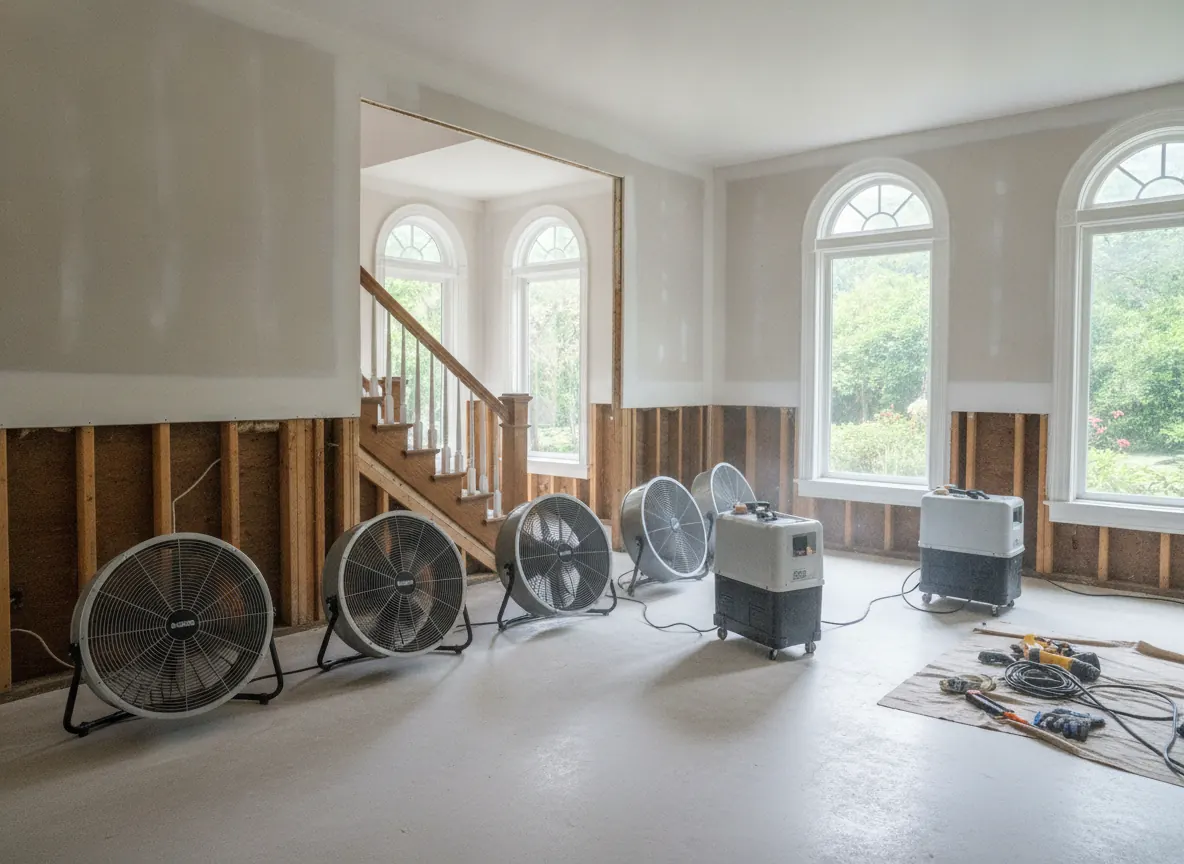
Carpet and pad, soaked insulation, and wet drywall are commonly cut out above the water line so wall cavities can dry.
Dry aggressively
Fans, dehumidifiers and, once power is safe, air conditioning. Open the home up when outdoor air is drier than indoor air.
Get help for bigger areas
The EPA says a homeowner can usually handle mold areas under about 10 square feet. Flooded rooms are usually well beyond that.
City of Charleston flood-zone permits for repairs
If your home is in the City of Charleston's Special Flood Hazard Area (Flood Zones AE and VE), the city says all work on an existing structure requires a permit. That includes storm-damage repairs, HVAC ductwork replacement and non-structural interior renovations. The city's Permit Center for repair permits is 843-577-5550, and permits must be obtained before repair work is completed.
The city also applies the "substantial improvement" and "substantial damage" rules: if repair or improvement costs over a one-year period reach 50% or more of the structure's market value (or pre-damage value, for damage), the whole building must be brought into floodplain compliance. A cost estimate and affidavit are required for permits close to that line, such as 45–49%. Other towns and Charleston County have their own permit offices, so check with yours.
Contractor rules also apply to the rebuild. Under SC Code §40-59-20, residential specialty work such as drywall or insulation above $500 requires registration, and residential builder work above $5,000 requires a license. South Carolina has no mold-specific license; a bill (H.5109) was introduced in 2026 but has not passed as of October 2026. This is general information, not legal advice. More in our South Carolina mold law post.
What flood mold cleanup typically costs
Cost guides list whole-house mold remediation after a flood at about $10,000–$30,000, and a typical single-area job at $1,200–$3,750. These are typical national ranges from cost guides, 2024–2026, not quotes. Insurance may cover some or all of the water damage, depending on your policy and the cause. See the mold remediation cost guide for more ranges.
Getting help after a storm
Charleston Mold Experts is a free quote service. We connect Charleston-area homeowners with local mold inspection and remediation companies for free, no-obligation quotes. After a storm, demand spikes, so ask every company about its training and certifications, insurance and who handles the rebuild, and get the scope in writing before work starts. Read about how flood work is usually approached on our flood & water damage mold page, then request free quotes. If anyone in the home has health concerns, talk to a doctor.
Frequently asked questions
How fast does mold grow after a flood?
The EPA says water-damaged areas and items should be dried within 24 to 48 hours to prevent mold growth, and South Carolina's environmental agency gives the same window. In Charleston's warm, humid weather, materials that stay wet longer than that, such as drywall, insulation and carpet pad, are at real risk of growing mold.
Do I need a permit for flood repairs in Charleston?
Inside the City of Charleston's Special Flood Hazard Area (Zones AE and VE), the city says all work on an existing structure needs a permit, including storm-damage repairs, HVAC ductwork replacement and interior renovations. Get the permit before repairs are completed. Other towns have their own rules. This is general information, not legal advice.
Can tidal flooding cause mold?
Yes. Any water that wets building materials can lead to mold if they are not dried within about 24 to 48 hours. Tidal flooding often reaches garages, ground-floor rooms and crawl spaces, which can stay damp because they are hard to see and ventilate. Check those areas after high-tide flood days.