
When a crawl space has mold, homeowners usually hear three options: remediation, encapsulation and a dehumidifier. They are often sold together, and the prices range from a few hundred dollars to five figures. They also solve different problems. This post lays out typical costs for each, what each one actually fixes, and how to tell which combination fits your crawl space.
How much does crawl space mold remediation cost?
Cost guides put crawl space mold remediation at about $500–$2,000 for a typical job. Encapsulation and a dehumidifier are separate line items. Here are the typical national ranges side by side:
| Item | Typical range |
|---|---|
| Crawl space mold remediation | $500–$2,000 |
| Crawl space encapsulation | $1,500–$15,000 (avg about $5,500; $3–$10 per sq ft) |
| Crawl space dehumidifier, installed | $800–$2,000 |
| Mold remediation, per square foot of affected area | $10–$30 |
| Mold inspection | $450–$800 (HomeAdvisor data via Bob Vila: $299–$1,014, avg about $656) |
These are estimates, not Charleston prices. No Charleston-specific cost data was found, and the real price comes from a company's on-site assessment of your crawl space. For more ranges by size and location, see the mold remediation cost guide.
What crawl space mold remediation solves
Remediation deals with the mold that is already there. A remediation company will typically:
- Assess how much of the framing, subfloor and insulation is affected.
- Remove wet or moldy insulation and debris.
- Clean or treat affected wood surfaces, often with HEPA vacuuming and scrubbing or other methods.
- Remove or replace badly damaged materials where cleaning is not enough.
What remediation does not do on its own is change the conditions that grew the mold. The EPA is direct about this: "If you clean up the mold, but don't fix the water problem, then, most likely, the mold problem will come back." In a Lowcountry crawl space, where August relative humidity averages around 79%, cleaning the wood without addressing the moisture is often a short-term fix.
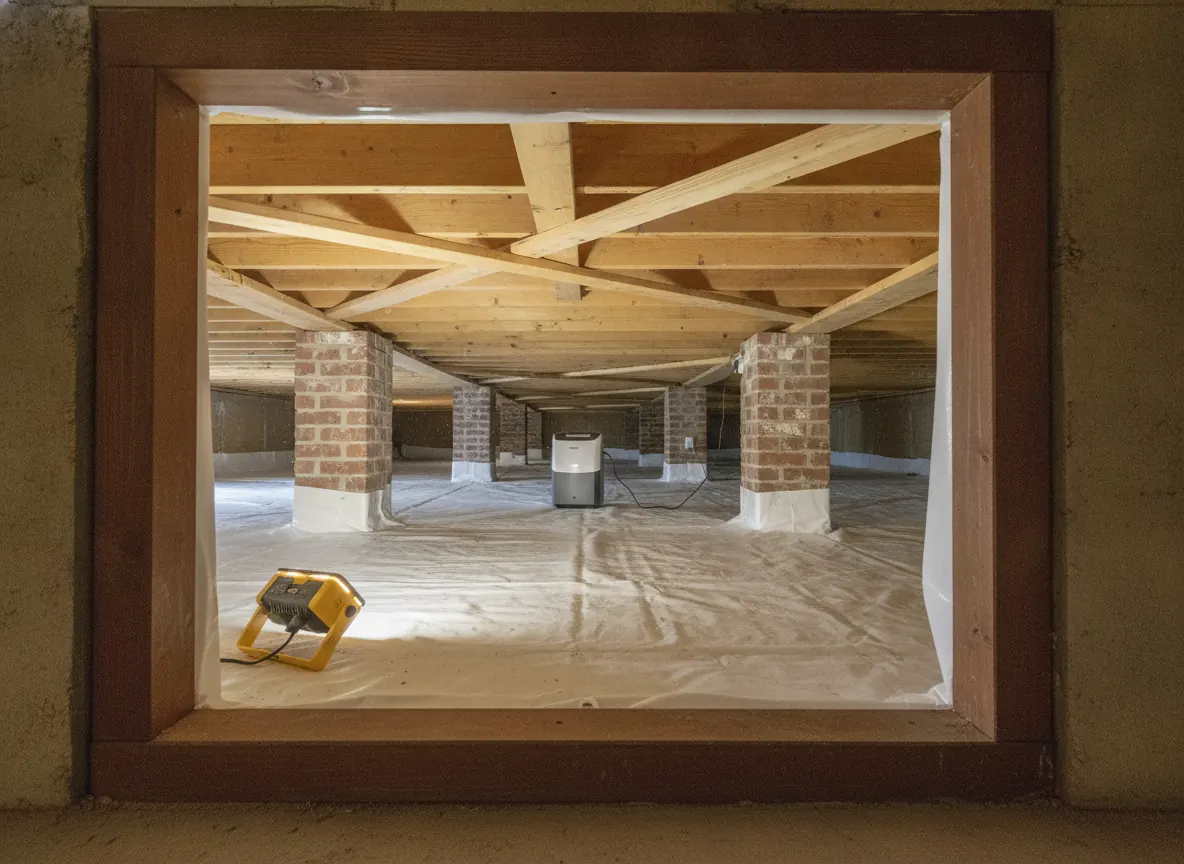
What crawl space encapsulation solves
Encapsulation changes the crawl space itself. Instead of a vented space that breathes outdoor air, it becomes a sealed, conditioned or dehumidified area. A typical encapsulation can include:
- A heavy vapor barrier over the ground, often run up the walls and piers and sealed at the seams.
- Sealing foundation vents and gaps to outdoor air.
- Sealing or insulating the crawl space walls in some designs.
- A dehumidifier or a conditioned air supply to control humidity.
- Drainage work, such as a sump, where water collects.
That is why the price range is so wide: $1,500–$15,000, with an average around $5,500, or roughly $3–$10 per square foot. A small, dry, easy-to-reach crawl space with a simple liner sits at the low end. A large crawl space with drainage problems, low clearance, debris to remove and a full wall system sits at the high end.
Encapsulation is about prevention. It does not clean existing mold. If there is active growth, remediation usually comes first, then the space is sealed.
What a crawl space dehumidifier solves
An installed crawl space dehumidifier runs about $800–$2,000. It pulls moisture out of the crawl space air and drains it away. On its own, it works most effectively in a crawl space that is already mostly sealed; in a fully vented crawl space, it is fighting the outdoors. That is why dehumidifiers are usually part of an encapsulation, or added to a crawl space that already has a good vapor barrier and closed vents.
Ask any company that recommends a dehumidifier how it will be drained, how the humidity will be monitored, and what maintenance it needs.
Which one do you actually need?
A simple way to think about it:
| Situation | Often discussed |
|---|---|
| Small patch of mold after a one-time leak that has been fixed | Cleanup only; possibly DIY if under about 10 sq ft |
| Widespread growth on joists, damp insulation, musty smell upstairs | Remediation plus a moisture plan |
| Mold returns every summer despite cleaning | Remediation followed by encapsulation and humidity control |
| Already encapsulated, but humidity is high | Check the liner, seals and dehumidifier before anything else |
| Standing water or flooding under the house | Drainage and drying first; mold work after |
For the small-patch case, see our post on the EPA 10-square-foot rule. If you are not sure whether what you are seeing is normal for a Lowcountry home, start with is crawl space mold common in the Lowcountry?
Can mold grow in an encapsulated crawl space?
Yes, it can, if moisture gets in. Common reasons include a torn or poorly sealed liner, a plumbing leak, groundwater coming in after heavy rain, a dehumidifier that has failed or is undersized, or mold that was not cleaned before the space was sealed. Encapsulation reduces the odds a lot when it is done well and maintained, but it does not rule mold out.
How to compare crawl space quotes
Because these three services are often bundled, quotes can be hard to compare. Ask each company to break out:
- Remediation scope: square footage treated, materials removed and cleaning method.
- Encapsulation materials: liner thickness, how far up the walls, vent sealing, drainage.
- Dehumidifier model, capacity, drain method and warranty.
- Any insulation, framing or HVAC work, and who performs it.
- What moisture source was found and how the plan addresses it.
South Carolina has no mold-specific license, so ask about training and certifications and insurance. Insulation or carpentry work above $500 can require SC residential specialty registration under SC Code §40-59-20(7). This is general information, not legal advice. Our South Carolina mold law post has the details.
Get free crawl space quotes
Charleston Mold Experts is a free quote service. We connect Charleston-area homeowners with local mold inspection and remediation companies for free, no-obligation quotes. Learn more on the crawl space mold & encapsulation page, or request free quotes and compare written scopes side by side.
Frequently asked questions
How much does crawl space mold remediation cost?
Cost guides put crawl space mold remediation at about $500 to $2,000 for a typical job. Encapsulation is separate, at about $1,500 to $15,000, and an installed dehumidifier runs about $800 to $2,000. These are typical national ranges, not quotes. The real price depends on an on-site assessment of your crawl space.
Is encapsulation better than mold remediation?
They do different jobs. Remediation removes or cleans mold that is already there. Encapsulation seals the crawl space from outdoor air and ground moisture to help keep mold from coming back. If there is active growth, remediation usually comes first, then encapsulation or other moisture control, depending on what is causing the dampness.
Do I need a dehumidifier if my crawl space is encapsulated?
Many encapsulation designs include a dehumidifier or a conditioned air supply, because sealing the space traps whatever moisture remains. Whether yours needs one depends on the design and how humid the space stays. Ask the company how humidity will be controlled and monitored, and what maintenance the equipment needs.